
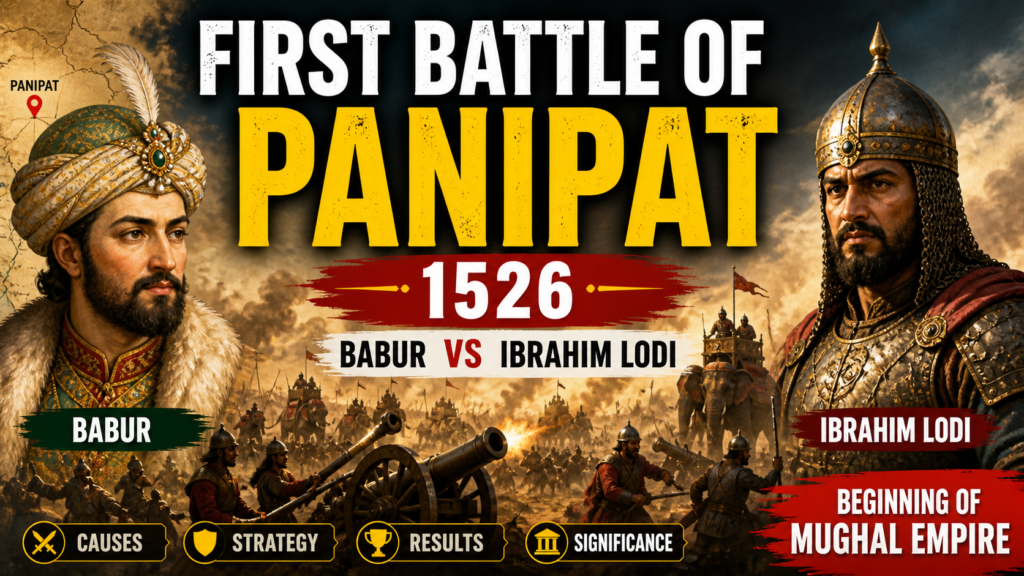
Imagine a battlefield in North India with lots of dust, thousands of warriors lining up and shouting, war elephant noises echoing, cannons banging, the first sounds of war. Ibrahim Lodi, with a huge army, was on one side. Babur, ruler of Kabul, with a smaller but very capable army, was on the other side.
It was the First Battle of Panipat that took place on 21st April 1526. Warfare of any kind did not occur; “only” the war which shaped the course of Indian history. The Battle ushered an end to the Mayor of the Delhi Sultanate and the commencement of a powerful Mughal Empire that was to rule India for centuries.
Students preparing for the UPSC, SSC, CDS, and School Examinations are definitely required to have an intimate awareness of this topic as Questions on the Battle of Panipat are generally present in the History Section of any competitive Examination.
In 1526, the first battle of Panipat took place.
Babur fought the First Battle of Panipat with Ibrahim Lodi near Panipat in the present-day state of Haryana. Although Babur was less in men, he won over Ibrahim Lodi due to the smartness of his plan, the superior weaponry and modern warfare techniques used by Babur.
This battle was made famous for the following reasons:
- It was the first phase of the rule of the Mughals in India.
- The first time gunpowder & cannons were used effectively in Indian warfare.
- Lodi was the end of the Lodi dynasty.
- Thereafter, Indian warfare was forever altered.
It is regarded as one of the largest pivotal moments in Medieval Indian History.
The political context before the battle.
Students should familiarize themselves with the condition of India in those days to comprehend the reason for this battle.
Weaknesses of the Delhi Sultanate
The Lodi Dynasty was in power in North India in the early 16th century. The Sultan of Delhi was Ibrahim Lodi, but the nobles were not all pleased with him. He was arrogant and hard to deal with for the chiefs and governors of the Afghan nation.
He was trying to control everybody strictly rather than build trust. This led him to have some nobles turn against him.
This internal weakness rendered the Delhi Sultanate weak.
Babur’s dream of conquering India was his vision.
His dream of conquering India was Babur’s.
Babur ruled Kabul and was a member of the great family of Timurids. He had already lost some territories in Central Asia and was in search for other lands where he could establish a powerful empire.
He found India to be a promising land due to:
- India was wealthy.
- Politically, the Delhi Sultanate was feeble.
- A few Indian nobles were ready to aid him.
Babur had invaded India multiple times before 1526, mainly targeting the Punjab areas. This time it was with a bigger agenda – to capture Delhi and rule over it for good.
Causes of the First Battle of Panipat
There were a number of reasons for this historic battle.
1. Weak Leadership of Ibrahim Lodi
Ibrahim Lodi knew that he was not keeping a good relationship with his nobles and military commanders. There were many who were not happy within his own kingdom.
There is no doubt that a ruler can have a vast army, but if he does not have support from his own people, then defeat is inevitable.
2. Invitation from Rebel Nobles
Babur was invited by some nobles and governors of Afghanistan to invade India. They wished Babur to take Ibrahim Lodi out of his office.
Daulat Khan Lodi and Alam Khan were important factors in pushing Babur to attack Delhi.
3. Babur’s Expansion Policy
Babur was ambitious. He wanted to establish a great empire and thought India was best suited.
Babur’s invasion in 1526 was different from the previous ones because this time it was conducted on a permanent basis.
4. Politische Unruhen in Nordindien
Many rulers at the time were battling for their right to rule. In North India, there was no solid national unity.
Babur knew this was a weak point in the fort and exploited it.
Date and Place of the Battle
| Topic | Details |
|---|---|
| Battle Name | First Battle of Panipat |
| Date | 21 April 1526 |
| Place | Panipat, Haryana |
| Opponents | Babur vs Ibrahim Lodi |
| Result | Victory of Babur |
Panipat later became famous because the three major battles fought there changed Indian history.
Army Strength of Both Sides
Babur’s Army
The army of Babur was better disciplined and better trained, but in less number.
His army included:
- Skilled cavalry
- Horse archers
- Matchlock soldiers
- Artillery units
Historians estimate that Babur was equipped with 12,000–15,000 men.
The biggest advantage Babur had was his cannons and guns.
Ibrahim Lodi’s Army
Ibrahim Lodi’s army was much bigger.
His force included:
- Around 40,000 to 1,00,000 soldiers
- Nearly 1,000 war elephants
- Large infantry units
Ibrahim Lodi was a lot stronger on paper. A winning combination isn’t made solely of numbers.
His army was undisciplined, poorly coordinated and had no knowledge of modern warfare.
Babur’s Military Tactics
The most significant part of the book for competitive exams is the section on Babur’s battle tactics, as it is always a common question asked related to it.
Tulughma Tactic
Babur divided his army into various parts. Fast cavalry units attacked the enemy from the sides and rear.
This meant confusion to Ibrahim Lodi’s army and the disruption of their formation.
Babur did not attack head-on with the whole army, but he displayed mobility and speed.
Araba System
Before the army, Babur tied ropes together carts. Behind these carts were cannons and gunmen.
This provided a sort of fortification and hindered the enemy’s direct attack.
Use of Cannons
Artillery fire was the deciding factor.
Cannon-firing was not a tactic that was used by the Indian armies. On the cannon’s firing, Ibrahim Lodi’s elephants were terrified by the sound.
The elephants in the army were scared, causing turmoil.
This proves how modern technology can be used to overcome even greater forces.
The course of the battle.
Babur arrived at Panipat before Ibrahim Lodi and laid his defense to great lengths.
Ibrahim Lodi came with his huge army with the assumption that it would be easy for him to win, as he had more soldiers and elephants.
But the battle did not go as expected.
As Ibrahim’s men moved forward, Babur’s guns began firing. The cannon frightened the elephants and caused the army to become disorganized.
At the same time, Babur’s cavalry attacked from the sides using the Tulughma tactic.
Soon the confusion spread throughout Ibrahim Lodi’s army.
It became impossible for the soldiers to manoeuvre properly and Babur’s disciplined army kept on hitting strategically.
Lastly, Ibrahim Lodi met his death in battle. Many of his soldiers also lost their lives.
Despite being outnumbered, Babur won a resounding victory.
Why Did Babur Win?
The following is another frequently asked exam question.
1. Better Leadership
Babur was an astute military commander who had already conducted a lot of battles in the past.
Ibrahim Lodi was short of strategy.
2. Modern Weapons
Babur employed cannons and guns successfully and Ibrahim Lodi depended primarily on the traditional way of warfare.
3. Strong Military Strategy
Babur enjoyed a great advantage in the form of his Tulughma and Araba tactics.
4. Unitedness of Lodi’s Army
Numerous nobles were not satisfied with Ibrahim Lodi and his soldiers were not united and faithful.
5. Disciplined Soldiers
Babur’s army was smaller in size, but more disciplined and trained.
The outcome of the first battle of Panipat.
The results of this battle changed Indian history forever.
The end of the Lodi Dynasty.
Ibrahim Lodi lost his life in the battle and the Lodi Dynasty was ended.
This brought the Delhi Sultanate to an end as well.
The Mughal rule started here.
On winning, Babur took Delhi and Agra.
It was the start of the Mughal Rule in India.
The introduction of gunpowder warfare.
The advent of gunpowder warfare.
The battle proved the importance of artillery and firearms in warfare.
Indian rulers began to pay more attention to gunpowder weapons after Panipat.
Indian Politics: A Transition of Some Kind
The battle changed the political structure of North India.
The Mughal later evolved into one of the most powerful empires in the history of India under the leadership of Mughals such as Akbar, Jahangir, Shah Jahan and Aurangzeb.
Historical Importance of the First Battle of Panipat
The First Battle of Panipat was deemed a turning point because:
- It was responsible for the establishment of Mughal power in India.
- It finally put an end to the rule of the Lodis in Afghanistan.
- It brought in new methods of war.
- It transformed the course of Indian politics for centuries.
The battle also proved an important lesson:
A smaller but disciplined and technologically advanced army can defeat a much larger force.
Also Read: The History of the Taj Mahal
Important Facts for Exams
| Important Point | Details |
|---|---|
| Year of Battle | 1526 |
| Date | 21 April |
| Place | Panipat |
| Winner | Babur |
| Defeated Ruler | Ibrahim Lodi |
| Famous Tactics | Tulughma and Araba |
| Importance | Beginning of the Mughal Empire |
Frequently Asked Questions (FAQs)
1. Which of the following battles was fought with the participation of Aurangabad?
Babur is fighting against Ibrahim Lodi.
2. When did the first battle of Panipat happen?
It was fought on 21 April 1526.
3. Why was 1st battle of Panipat important?
It was the first time that the Mughals ruled in India, and the last time that the Delhi Sultanate got established in the country.
4. What were the problems that Ibrahim Lodi failed?
He was defeated due to his poor leadership, lack of military strategy and the absence of modern weapons.
5. Which one of Babur’s abilities was the strongest?
The strongest weapon of Babur was his artillery and military strategies.
Conclusion
The first battle of Panipat was not fought between two kings. It was a battle that shaped Indian history.
After Babur defeated Ibrahim Lodi in 1526, a new beginning started. The Delhi Sultanate was over and the Mughal Empire came into being. The battle is also considered to be the beginning of the use of gunpowder in India, which changed the character of wars.
This topic will be of particular importance to students because it is channeled through four aspects of political history, warfare, leadership and change in history all in one chapter. The First Battle of Panipat is very significant in the understanding of the reasons, events and importance of the change of the medieval period into a new phase in the rule of the Mughals in India.