
The impact of artificial intelligence on employment
As artificial intelligence becomes more and more used, some career possibilities might drop. For low-skilled people, automation in the manufacturing and storage sectors might, for instance, reduce employment. Though it might be challenging, this also suggests that we should update our skills. In the present day, technology is always developing to hitherto unheard-of degrees. Apart from promises to change our lives, artificial intelligence (AI) has significantly affected the field of jobs as well. Have you ever considered how future artificial intelligence may affect your employment? This essay will look at how artificial intelligence affects professions, therefore embracing both positive and negative effects.
What is AI?
Artificial intelligence is AI. It is the development of computer systems capable of learning, solving problems, and making decisions—jobs often requiring human intellect.
Artificial intelligence (AI) refers to the technology that allows computer systems and software to carry out intellectual activities that mirror those done by people. It works in areas such as machine learning, data analytics, and natural language processing. Consider it as a system that answers your questions or accomplishes your tasks quickly and precisely—this is the genuine enchantment of AI.
The arrival of artificial intelligence in the field of work
Artificial intelligence (AI) is currently being applied across different fields. Businesses and businesses are using it to make their work more efficient and effective. This is not only changing the work process but also giving new chances.
Positive benefits of AI
Creation of new jobs
The impact of artificial intelligence on employment for more benefits in new jobs is one of the main. If some conventional jobs might be replaced by automation, artificial intelligence is creating new ones in other sectors. For jobs like data scientists, artificial intelligence developers, and machine learning professionals, for example, the need is growing.
Demand for technical talents
With the advancement of AI, the demand for technical talents has also expanded. Companies are seeking people who can grasp and use AI technologies. This is bringing new issues and potential for workers.
Increased productivity and efficiency
AI has enhanced productivity and efficiency tremendously. Suppose, a software that processes data reliably and creates reports—it reduces your human errors and completes duties faster. This boosts the efficiency of the corporation and benefits the business.
Less automation and human mistakes
Automation driven by artificial intelligence is lowering human mistake rates. Chatbots, for instance, help with customer service and help to lower pharmaceutical dosage errors. This guarantees a great degree of accuracy in addition to making work easy.

Drawbacks of artificial intelligence
Lack of chances for a job
The impact of artificial intelligence on employment As artificial intelligence becomes more and more used, some career possibilities might drop. For low-skilled people, automation in the manufacturing and storage sectors might, for instance, reduce employment. Though it might be challenging, this also suggests that we should update our skills.
The threat of low-skilled tasks
Low-skilled tasks, such as data entry or simple calculations, may be automated by AI. This may restrict work possibilities for folks who do not have excellent technical skills. This problem can be especially acute in developing countries.
Social and economic inequities
The impact of artificial intelligence on employment can cause disparities in society. People with great technical skills may prosper, whereas low-skilled folks may be left behind. This can aggravate the problem of unemployment and income inequality, which needs to be controlled correctly.
Inequality of Income and Unemployment
AI can lead to a rise in unemployment and economic inequality. People without highly specialized skills may find it challenging to obtain job as technology replaces low-skilled labor. This can further increase economic inequality.
A balance between AI and Human Labor
Working with AI
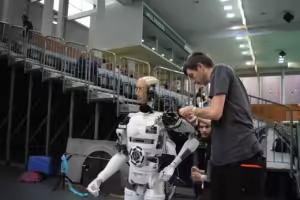
AI does not mean that the necessity for human labor will cease. In reality, the correct balance of AI and human labor can make employment more effective. For example, working with AI can allow human workers to focus on more creative and strategic activities.
Need for Skill Upgradation
To work with AI, we have to regularly refresh our expertise. There will be a need to master new technical tools and software so that we may better adapt ourselves in the world of AI. Skill upgradation is the necessity of the hour.
Ethical and legal aspects
Ethical and legal problems also arise relating to the usage of AI. How to ensure that AI is used for the benefit of humanity? Are the decisions made by AI always correct? To discover answers to these issues, we must create suitable policies and regulations.
Future direction
AI and the future of employment
The future of AI will bring big changes in the realm of employment. It will produce new jobs, but at the same time, some traditional jobs may also be removed. We have to be prepared for this transition and upgrade our skills.
Potential Employment Fields Associated with AI
Potential employment categories related to AI include health care, education, and financial services. The deployment of AI technology in these sectors can not only boost production but also generate new career prospects.
Conclusion
The right use of AI
Using AI appropriately can give us greater chances and the well-being of society. It is our job to ensure its correct and ethical use. We have to work towards a balanced and inclusive future with AI.
New employment opportunities
The impact of artificial intelligence on employment With the expanding utility of AI, new career opportunities are also being generated. We should take advantage of this transition by expanding our capacities and gaining new skills. Together with AI, we can strive towards a better and more advanced future.


FAQ’s
The impact of artificial intelligence on employment
1. Will AI replace humans in every job?
Artificial intelligence can mechanize certain occupations, however, it is important to note that it also leads to the emergence of novel work opportunities. Therefore, not every employment will be eradicated.
2. What skills are needed to study AI?
Programming, machine learning, and data analysis are examples of technical skills required to use AI.
3. Will AI usage lead to increased social inequality?
Inequalities in society may rise as a result of AI use, although this may be mitigated with the right rules and skill development.
4. How may AI be used to address the issue of unemployment?
The creation of new employment and skill upgradation are important to work with AI. This can mitigate the issue of unemployment.
5. How can the balance between AI and human work be maintained?
The appropriate balance of AI and human labor may make employment more effective. Balance may be maintained via skill upgradation and the correct usage of AI.
6. Are you interested in eco-friendly home renovation with the help of eco-home styles?
interested visit: ecohomestyles.online