
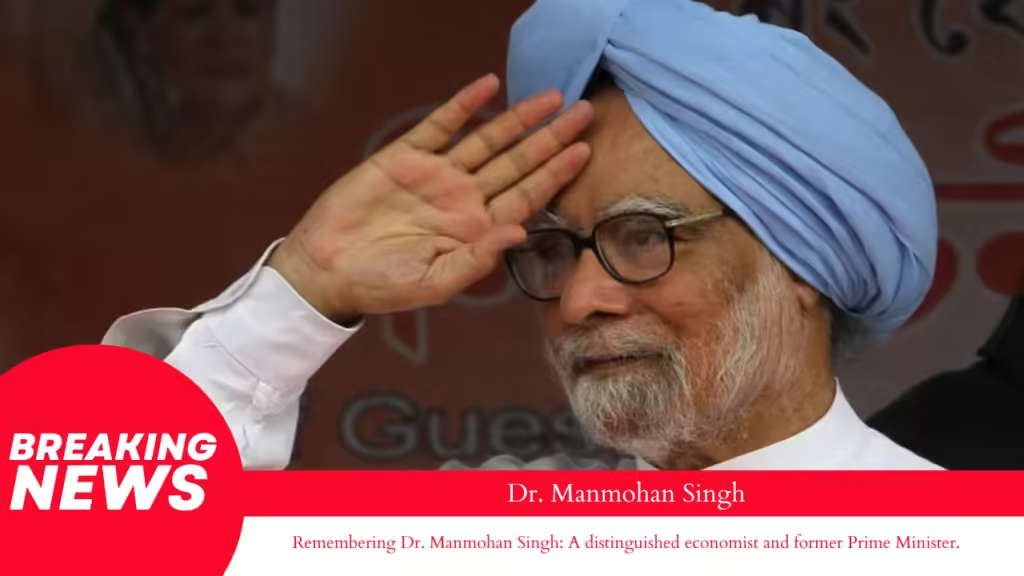
A Legacy of Leadership and Economic Transformation: Dr. Manmohan Singh’s Contributions to India
In the beginning, Dr. Manmohan Singh was a respected economist and a former Prime Minister of India. He was born on September 26, 1932, in the province of Punjab, which was then a part of British India. The successes that Singh has accomplished have left a lasting imprint on the political and economic landscape of India. Singh is highly renowned for his critical role in liberalizing India’s economy. This article addresses his remarkable journey, accomplishments, and legacy in full.
Childhood and Instructional Years
Dr. Manmohan Singh’s early life was marked by academic excellence. Following the conclusion of his elementary school in Punjab, he went on to seek higher education in the United Kingdom. He earned with a First Class Honours degree in Economics from the University of Cambridge in 1957 and a Doctor of Philosophy degree in Economics from Nuffield College, Oxford, in 1962.
Academic and Professional Career
Singh’s career began in academia, teaching at Punjab University and the Delhi School of Economics. In 1971, he joined the Government of India as an Economic Advisor in the Ministry of Commerce. He then served numerous crucial responsibilities, including Chief Economic Advisor in the Ministry of Finance (1972-1976), Governor of the Reserve Bank of India (1982-1985), and Deputy Chairman of the Planning Commission (1985-1987).
Reforms to the Economy
With a budget deficit of 8.5% and foreign exchange reserves that were just barely sufficient to pay two weeks’ worth of imports, India was in the middle of a catastrophic economic crisis in the year 1991. As Finance Minister under Prime Minister P.V. Narasimha Rao, Dr. Singh undertook a variety of economic measures, including devaluing the rupee, cutting taxes, privatizing state-run firms, and encouraging international investment. These developments were vital in altering India’s economy and setting it on a route to global prominence.
Political Career
Dr. Singh joined politics in 1991 and was elected to the Rajya Sabha. He served as Leader of the Opposition from 1998 till 2004. In 2004, following the Indian National Congress’s electoral victory, Singh became the Prime Minister. During his reign from 2004 to 2014, he focussed on economic growth, social welfare, and education.
Major Achievements
Under Singh’s leadership, India experienced considerable advances in GDP growth, decrease in poverty, and increased foreign investment. His policies and reforms in various sectors, including education and healthcare, have had a long-lasting effect on the nation.
Personal Life
Known for his humility and intellect, Dr. Singh remained dedicated to public service throughout his life. His scholastic and professional achievements are a tribute to his continuous dedication to India’s progress.
Legacy
Dr. Manmohan Singh’s leadership and economic policies have had an enduring influence. His vision and dedication altered India’s economic climate, gaining him plaudits both domestically and abroad.
Final Farewell
Dr. Manmohan Singh passed away on December 26, 2024, at the age of 92. His death was regretted by politicians and civilians alike, marking the end of an era.
Also Read: Defence Research and Development Organisation(DRDO)
Visit Yt: CDLU Education
Conclusion
Dr. Manmohan Singh’s path from a poor academic to a revolutionary leader is a tribute to his vision, passion, and unshakable devotion to India’s success. His legacy will continue to inspire future generations.