
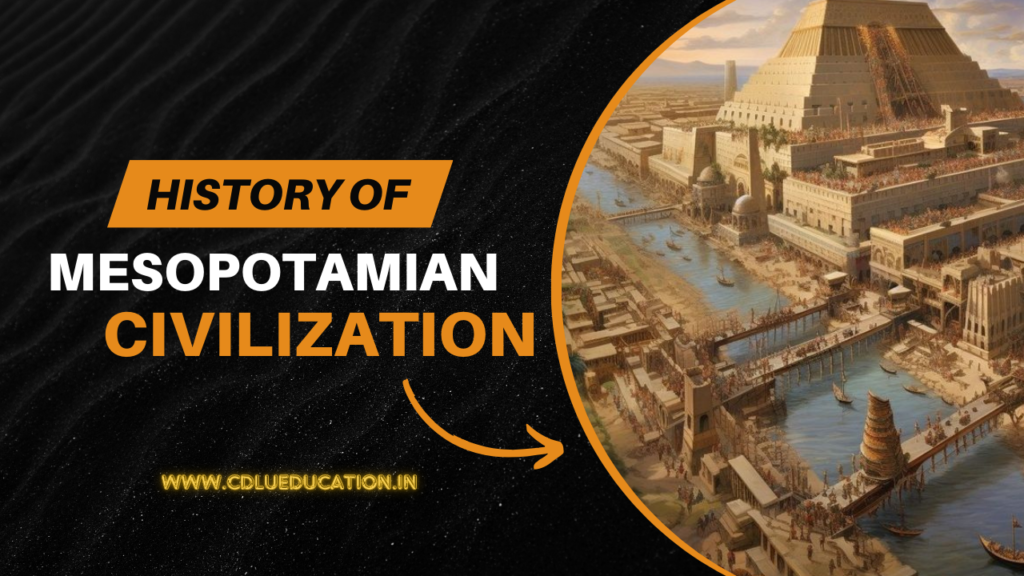
History of Mesopotamian Civilization
introduction
Do you want to enter the world of ancient civilizations? So come on, welcome to the family of Mesopotamian culture! The history of this ancient civilization is very rich and full of diversity. In this article, let us study various aspects of Mesopotamian culture.
What is Mesopotamia?
Mesopotamia means “two rivers”, referring to the two rivers Tigris and Euphrates. This ancient land extended into present day Iraq and Syria.
Characteristics of Mesopotamian culture
These cultures are characterized by their interdependence, unique writing systems, and religious diversity. This culture gave mankind the precious treasures of writing, mathematics, and architecture.
Origins of Mesopotamian Civilization
Causes of origin
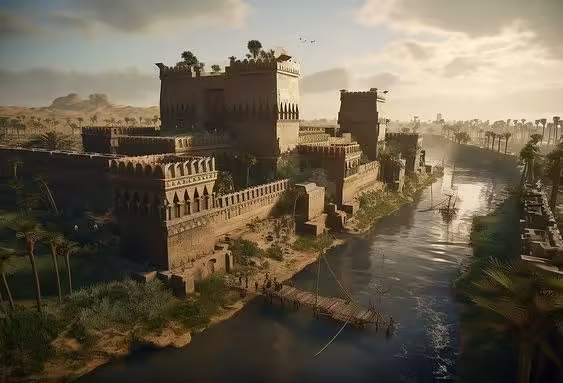
The Mesopotamian culture originated from a specific geographical situation. Located on the banks of the Tigris and Euphrates basins, this culture developed due to the abundant production of food grown in the area.
Cultural development
This culture developed many aspects of the modern world. He witnessed innovations in piety, writing, and administration of power.
Important urban centers
Sumer
Sumer was a very important city in Mesopotamia. Sumerians developed basic writing, mathematics and electricity.
Acad
Akkad was an ancient kingdom located north of Sumer. His linguistic and administrative skills are admired even today.
Babylon
Babylon was a major city in the Mesopotamia region, whose influence led to cultural and economic transformation throughout the region.
Social and Political System
Political structure
Mesopotamian culture had a highly complex and idealized system of political system. The king had given functional systems to various departments, which made the administration efficient.
social class
Differentiation and division were very important in social classification. There were different levels in society, each level had its own rights and duties.
Religious and cultural life
Religious deities and worship
Deities and worship were extremely important in Mesopotamian religious life. Technology and ethics were studied for various deities and their worship rituals.
cultural traditions
Cultural traditions and customs were an integral part of Mesopotamian people’s lives. Art, music and dance were enjoyed.
Writing and Language
Cuneiform writing
Cuneiform writing is a treasure of Mesopotamian culture. This writing system helped preserve their social and cultural information.
Language and Literature
The use of language and the production of literature shaped the ideology of Mesopotamian society. His literature has shed light on many perspectives.
Scientific and technological progress
Scientific contribution
Mesopotamians made significant contributions to mathematics, astronomy, and medicine. His research played an important role in the development of modern science.
Technological innovation
Technological innovations brought innovation to Mesopotamian culture. He made special progress, especially in the fields of water conservation systems and architecture.
Decline and Legacy
cultural decline
Over time the Mesopotamian culture declined, but the richness of their cultural deposit lives on today.
Legacy and influence
The legacy and influence of Mesopotamian culture on modern cultures is huge. Many things have come into existence in today’s world due to his contribution.
conclusion
The history of Mesopotamian civilization is an amazing and inspiring story. His contributions to science, writing, and religion continue to teach us how ancient ideas and technologies shape the modern world.


Pingback: Evolution of Human Society: A1 Journey Through Time and Innovation - CDLU Education