
Evolution of Human Society
The Evolution of Human Society is an interesting and challenging process. This voyage encompasses many events and situations, which have built the basis of our modern civilization. In this essay, we will analyze in depth the Evolution of Human Society, and the notion of caste, tribe, and family.
Human Society in Ancient Times
The Age of Hunting and Gathering
The early stage of human civilization in ancient times was centered on hunting and gathering. In this age, humans lived in tiny groups and wandered about in quest of sustenance. The framework of these societies had a rudimentary social order, with no fixed dwelling.
Effect of Agricultural Revolution
The Agricultural Revolution was a pivotal point in the Evolution of Human Society. This revolution brought people to permanent settlement and an agriculture-based lifestyle. The introduction of agriculture not only provided stability for food but also produced important changes in the Evolution of Human Society.
Concept of Caste
Origin of Caste
The history of the genesis of the caste system is quite ancient. This system has been notably widespread in India, where the society was separated into several castes. In the early ages, the cornerstone of the caste system was karma and guna.
Evolution of the Caste System
Over time, the caste system developed a hard shape, and a severe discipline was observed in the culture. The rights and obligations of the people were decided based on caste.
Social Impact of Caste System
The caste system had a major influence on the society. It encouraged social stratification and hindered social mobility. The caste system gave birth to division and inequity in the community.
Concept of Tribe
Origin of Tribes
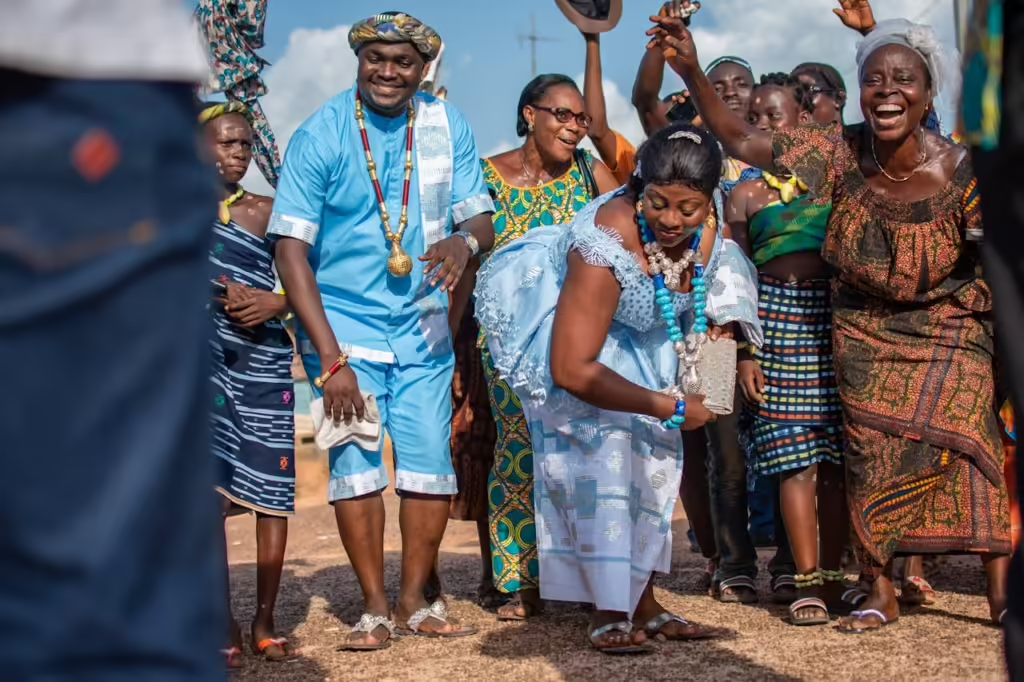
The genesis of tribes is tied to ancient human groupings, who lived in distinct geographical locations and had their customs and traditions. These communities were self-sufficient in itself.
Organization of Tribes
The structure of tribes was fairly collaborative and cooperative. They used to manage their sources of living by collaborating. Their social structure was basic and leadership was mainly in the hands of older individuals.
Modern Tribal Society
Even now, tribes attempt to retain their ancient lifestyle, but the effect of civilization and progress has significantly changed their existence. Tribes still retain their distinct culture and customs, which sustain their uniqueness.
Concept of Family
Importance of Family
Family is the primary unit of society. It is the area where a person’s life starts and where he obtains fundamental education and sanskar. The value of family is also increased since it plays a significant part in the emotional and social growth of a person.
Types of Family
Families are basically of two types: joint family and nuclear family. In a mixed family, many generations live together, whereas in a nuclear family, just parents and their children dwell. Both sorts of families have their rewards and problems.
Changing Relationships in the Family
Relationships in the family have also altered throughout time. The necessity of greater independence and equality has risen in today’s households. Traditional values and attitudes are also shifting, which are altering the structure and functioning of the family.

Place of Family, Caste, and Tribe in Society
Social Organization and Structure
Family, caste, and tribe are significant components of the framework of society. All of them combined shape the organization and Evolution of Human Society. Family offers support and security at the individual level, while caste and tribe give a larger social identity and structure.
Changes in Modern Society
Modern civilization has witnessed major changes in the roles of family, caste, and tribe. Urbanization, education, and economic growth have challenged their traditional structures and duties. People have now grown more autonomous and self-reliant, which has also affected the structure of society.
Conclusion
The Evolution of Human Society is a continual process. The notions of caste, tribe, and family are key cornerstones of our society, which help us comprehend our identity and social structure. Though they have experienced various alterations throughout time, their essential essence persists even now.


If are you interested in eco-friendly home renovation ideas you must visit the: ecohomestyles.online
FAQ
1: What are the historical perspectives of the ancient past?
Historically, the caste system is rooted in ancient history from the Vedic period of Ancient India and was based on categories or jatis.
2: What is the difference between tribe and caste?
Tribes are groups that live in specially identified geographical regions and they have their identity while a caste is a social structure of society that mostly dwells into the Indian subcontinent.
3: What are the question types of family?
Two basic types of families are extended family and nuclear family.
4: How did the Agricultural Revolution affect human society?
The founding event of global landscape change was the agricultural revolution, which allowed human society to undertake permanent settlement and agriculture-based living styles that led to major changes in socio-political structure.